
This week we had the opportunity to attend the “Living with Permacrisis: Care, Responsibility, Agency and Art” conference organised by the UCD Humanities institute (https://www.ucd.ie/humanities/) and hosted by the Centre Universitaire de Norvège à Paris – Fondation Maison des sciences de l’homme ( https://www.fmsh.fr/). Bringing together scholars from philosophy, literature, history, cultural studies, art, geography and the environmental humanities, this two-day conference explored a timely question; what does it actually mean to live with crisis when crisis no longer feels exceptional, but increasingly becomes the background condition of everyday life?
Together with Jakleen Al-Dalal’a we presented our paper ‘Radical Care: Slow Mapping in a Time of Permacrisis’. Drawing on our work within the CHRYSES project (https://chryses.aalto.fi/), we explored what crisis mapping might look like when it refuses the pressure for quick and instant visibility of crisis events, which is the typical digital humanitarianism-type of crisis mapping. Much of contemporary crisis response – particularly using digital systems – translates harm into indicators, metrics and dashboards. While these systems often claim neutrality, they can also distance us from the lived realities of contemporary crisis, reducing complex human and environmental experiences into something measurable, manageable, and governable.Yet, as wider crises of public trust increasingly show, what appears governable through data does not necessarily become socially legitimate, publicly trusted, or meaningfully understood.
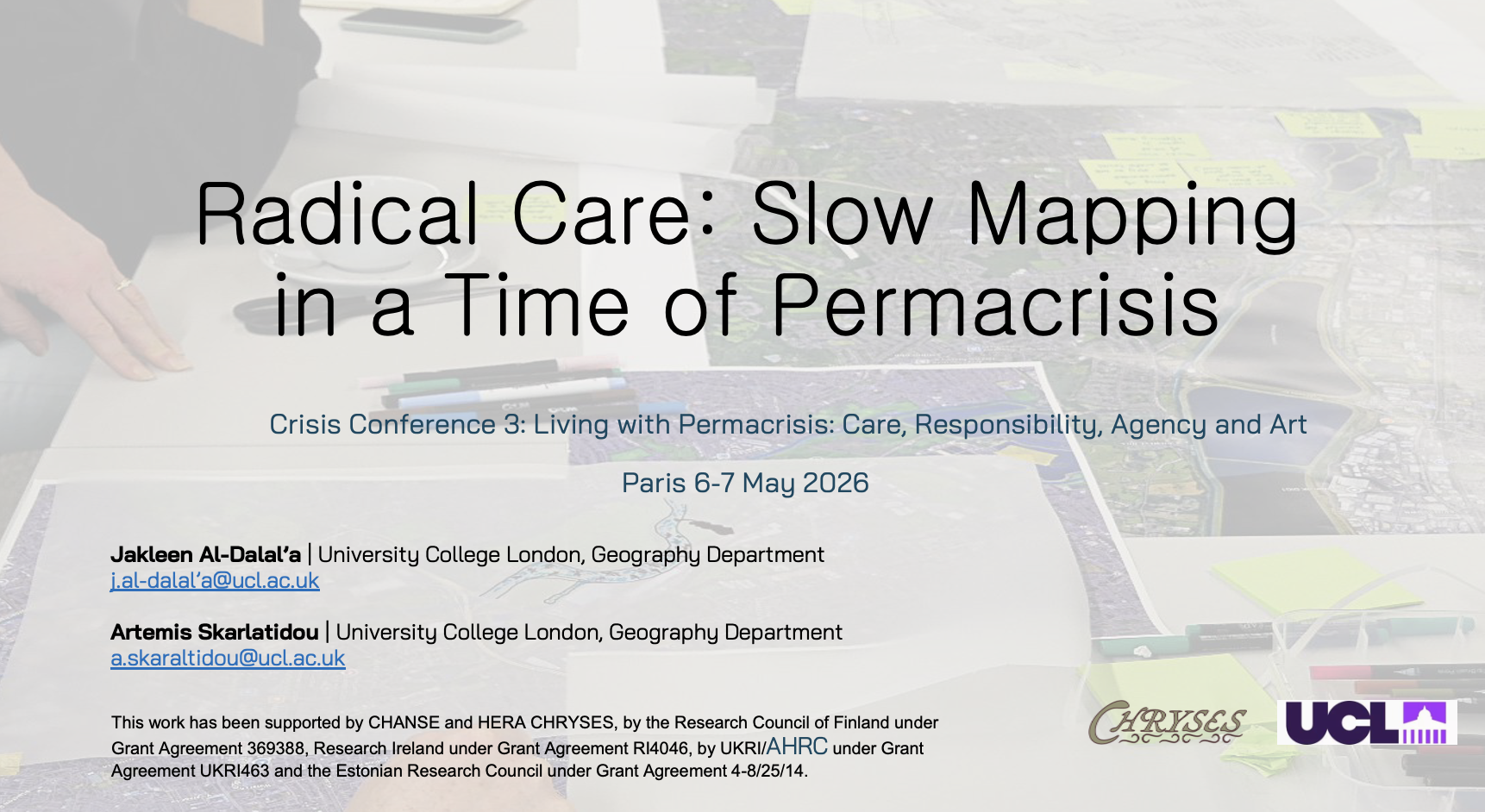
Our argument was that not everything, especially under conditions of permacrisis, should be accelerated, quantified, or translated into the traditional sense of data points. While data can help make certain patterns of harm visible, it often struggles to capture what it actually means to live with crisis, and the conditions crisis creates within local environments, communities, and everyday life. Contemporary crises do not always fit neatly into indicators, predictive models, or crisis mapping dashboards. They require care, attentiveness, and responsibility, which in turn require slowness, listening, and new ways of imagining how digital systems might represent crisis without flattening its complexity. They require us to rethink what becomes visible through digital infrastructures, whose experiences are made legible, and how particular forms of visibility ultimately shape how crises are understood, responded to, and governed.
What we found particularly refreshing was how strongly the humanities pushed back against dominant crisis narratives. Instead of asking how to “solve” crisis, many speakers asked how crisis reshapes memory, identity, ethics, embodiment, creativity…There were fascinating discussions on witnessing as political care, on the role of literature in making visible forms of epistemic injustice, on art as a response to the war in Ukraine and to the big data infrastructures and their environmental impacts, on ecological entanglement, and even on Catherine Malabou’s idea of destructive plasticity as a way of thinking about rupture, transformation, and agency after life-changing events. A recurring idea across panels was that living with permacrisis is not about resilience in the neoliberal sense of endlessly adapting and moving on. It is more about attentiveness, relationality, endurance, and learning how to remain ethically present within conditions of crisis.
As we are working at the intersection of citizen science, mapping, participation, and environmental governance, we left Paris feeling intellectually challenged and inspired. At a time when responses to crises are increasingly framed through big data, AI, predictive systems, digital technologies and so on, the humanities offered an important space for critical reflection, ethical questioning, and deeper engagement with what contemporary crises actually mean for people, places, and the environments they inhabit.
This work has been supported by CHANSE and HERA CHRYSES, by the Research Council of Finland under Grant Agreement 369388, Research Ireland under Grant Agreement RI4046, by UKRI/AHRC under Grant Agreement UKRI463 and the Estonian Research Council under Grant Agreement 4-8/25/14.


