
Environmental crises are often monitored through technical indicators, datasets, and institutional reporting. Yet they are also lived, sensed, and negotiated through everyday experience, in how people notice change, remember loss, and care for the environments around them. What happens when these lived experiences become a form of evidence? How can mapping capture crises not only as a physical condition but as a social and embodied reality?
On 31 January 2026, residents, river users, and local community organisations came together at UCL East for a participatory workshop exploring lived experiences of crisis along the River Lea. The session formed part of the CHRYSES project [https://chryses.aalto.fi/], an international research collaboration that examines how environmental health crises are understood, remembered, and communicated through maps, stories, and community knowledge. The workshop was delivered in collaboration with Manifold: a new art project for UCL Multi Lab that creates opportunities for multi-directional learning between UCL and its local communities.
The workshop was led by Dr Jakleen Al-Dalal’a (UCL Geography, ExCiteS/PNL) and Dr Artemis Skarlatidou (UCL Geography, ExCiteS/PNL), in collaboration with visual artist Emma Smith (Manifold), with support from Kate Watson (Multi Lab Community Engagement Officer at UCL Cultural and Community Engagement). Together, the team aimed to understand how UCL can best support local communities in their ongoing efforts to care for and improve the river.
The workshop created space for participants to reflect on their everyday relationships with the river and to share observations gathered through daily routines such as walking, cycling, boating, and long-term residence in the area. These experiences revealed clear concerns about ecological decline, including oil pollution, visible waste, unpleasant water conditions, invasive plant species, and the disappearance of fish in some locations. Participants also described potential health risks linked to polluted water, alongside a broader sense that river conditions have worsened in recent years.
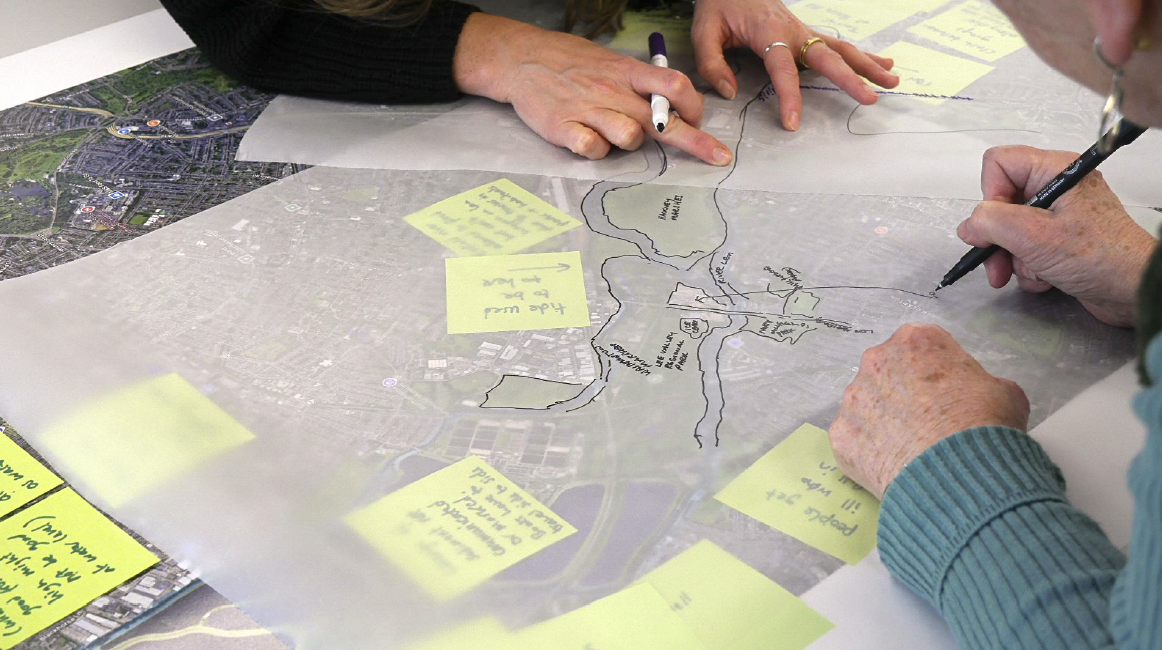
Image: Layered tracing and annotation created by participants during the River Lea mapping session. Photo by Kate Watson
At the same time, conversations highlighted the river’s social and emotional significance. Many participants recalled earlier memories of a cleaner river and spoke about the role the river continues to play in wellbeing, recreation, and connection to place. This coexistence of concern and attachment shaped much of the discussion, showing how environmental change is experienced not only as a physical process but also as a lived and felt reality.
Questions of governance emerged as a central theme. Participants expressed uncertainty about which institutions are responsible for monitoring pollution or responding to community reports, describing a perceived gap between local observation and visible action. These reflections pointed to wider challenges in environmental management, where responsibility appears fragmented and community knowledge is not always recognised within formal decision-making processes.
Participatory mapping provided a shared method for bringing these experiences together. Using large printed maps, tracing layers, colour, and annotation, participants translated memories, concerns, and places of care into visual form. This process enabled different perspectives to be discussed collectively and demonstrated how mapping can function as a tool for communication, reflection, and visibility rather than only technical representation.
The workshop placed particular emphasis on understanding the environmental crisis as something lived, felt, and collectively experienced; not only measured through scientific indicators or institutional reports. Through creative and art-based participatory mapping, participants explored how crisis is encountered in everyday life, in memories of a changing river, in practices of care, and in the emotional and social ties that connect people to place. Using drawing, layered tracing, colour, and visual storytelling, participants mapped sites of pollution and ecological concern alongside spaces of attachment, wellbeing, and possibility. This process revealed not only shared anxieties about environmental decline but also elements of hope and connection that could serve as starting points for collective action. By bringing artistic practice into the mapping process, the workshop made visible forms of knowledge, experience, and responsibility that often remain unrecognised, demonstrating how creative methods can open new ways of understanding environmental change and imagining more inclusive pathways for community-led response.
Such engagement lies at the core of the CHRYSES project, which seeks to strengthen public understanding of environmental health crises by connecting scientific approaches with cultural memory and local knowledge through interdisciplinary collaboration and public participation. Dr Artemis Skarlatidou (UCL Geography), UK Principal Investigator of CHRYSES project, explains: “Across the UK, concern about river pollution is generating vast amounts of data; from citizen science monitoring and storm overflow dashboards to AI-driven water quality prediction models. But data alone cannot capture what it means to live with a polluted river. Everyday experiences of those who use and care for rivers often remain invisible in environmental evidence and decision-making. This workshop shows that lived experience is essential to recognising environmental crises and must be more fully integrated into how environmental change is understood and addressed”.
CHRYSES workshops are now being held across Europe and aim to develop new ways of engaging communities and stakeholders in how crises are represented, understood, and governed. The River Lea workshop represents an early step in an ongoing process of collaboration between researchers, communities, and local organisations. Future activities will continue to share the co-created maps, deepen dialogue with institutions, and explore how participatory knowledge can support more responsive environmental governance.
Local concerns about the River Lea raised during the workshop will also inform further opportunities for creative engagement through Manifold: an art project to deepen understanding of human entanglement in local and global ecologies.
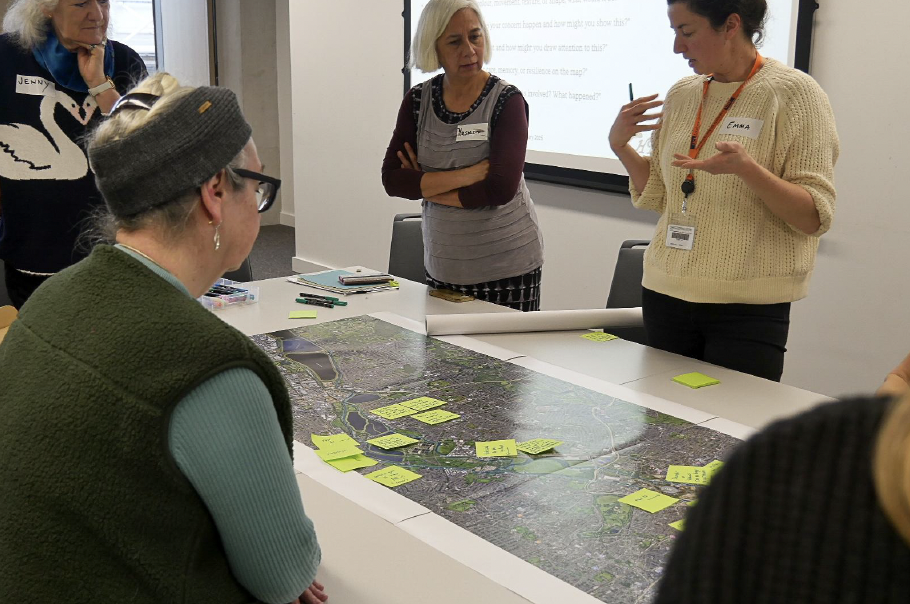
Image: Community discussion with artist Emma Smith around the River Lea base map during the CHRYSES workshop. Photo by Kate Watson.
This work has been supported by CHANSE and HERA CHRYSES, by the Research Council of Finland under Grant Agreement 369388, Research Ireland under Grant Agreement RI4046, by UKRI/AHRC under Grant Agreement UKRI463 and the Estonian Research Council under Grant Agreement 4-8/25/14.

 Extreme Citizen Science blog