
With every conference of the International Society of Ethnobiology (ISE) that I attend, I increasingly realise how unique and remarkable these meetings and group of people are.
Thanks to funds provided through ExCiteS and it’s co-director Muki Haklay, I was able to make the journey over to Marrakech, Morocco, for the 2024 ISE conference on Biodiversity and Cultural Landscapes: Scientific, Indigenous and Local Perspectives. The meeting took place from 15-19th April on the campus of Cadi Ayyad University with a huge variety of talks, roundtables, training sessions, exhibitions, knowledge-sharing sessions, and fieldtrips. The last ISE conference I attended, held in Kingston, Jamaica, offered the same bounty of sessions (see my post about that here).

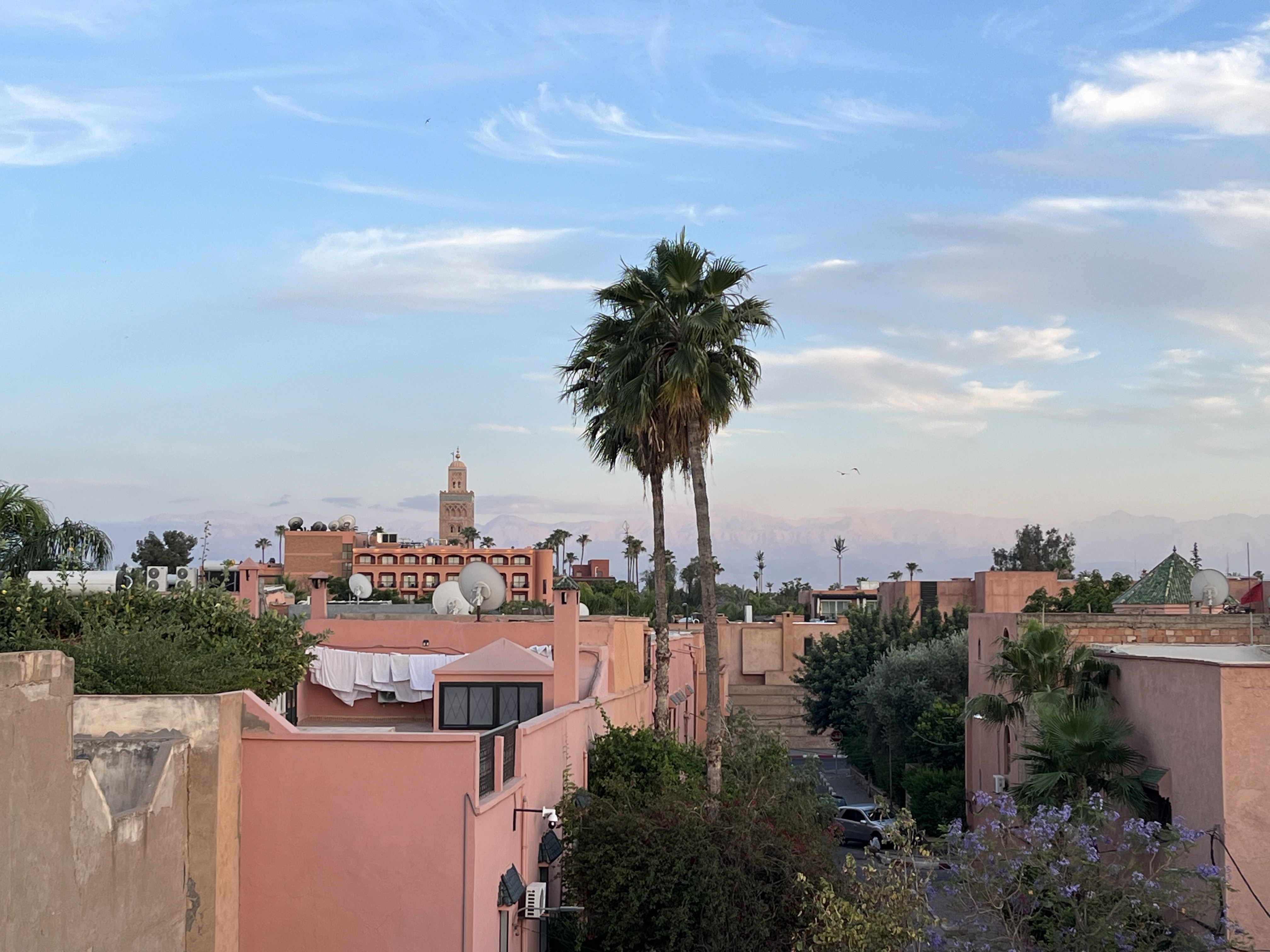
Cadi Ayyad University campus and the backdrop of the Atlas Mountains behind Marrakech
Similarly to the Jamaica conference, Morocco was chosen for very good reasons: the country has high biological and cultural diversity – more than 24,000 animal and 7,000 plant species (25% of these only found in Morocco), the array of landscapes from desert and mountains to coastal and forest also nurturing a variety of cultural practices and traditions. Strong and ancient cultural ties to agriculture persist which “have allowed farming of very arid areas, transforming the desert into a true garden”1.
The Indigenous Peoples of Morocco, commonly known simply as ‘Berbers’ or Amazigh but made up of at least four different distinct ethnic groups with their own languages, cultures and histories, largely inhabit the Atlas Mountains, the foothills of which provide the stunning backdrop to Marrakech. Many Moroccan Amazigh communities inhabit the High Atlas, roaming the valleys of their ancestors with livestock, sculpting sloping terraces, foraging for wild plants which have both subsistence and medicinal properties, and honouring sacred sites. Amazigh farming has been identified as an ‘agro-ecological system’ because the practices used benefit both agricultural production and the local ecosystems, for example through agroforestry, careful water management, culturally-managed trees, and soil conservation2. It is this inseparable bind between human cultures and local ecosystems that ethnobiology and environmental anthropology aim to study with the view that the breakdown of such a relationship is the primary cause of our current environmental and social crises.
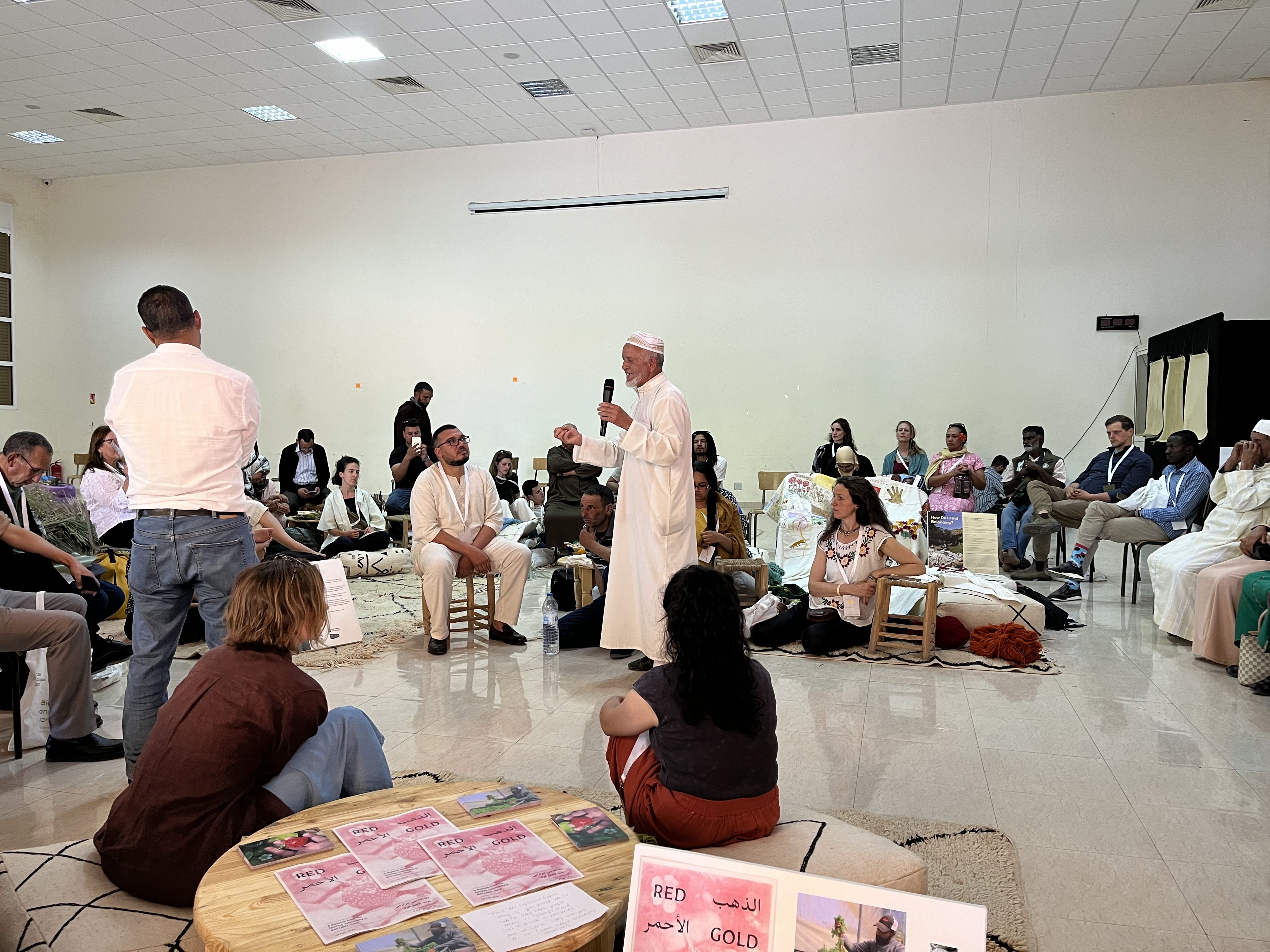
To illustrate how this can directly influence the domain of nature conservation, the concept of ‘biocultural heritage territories’ was presented by a team from the UK and Kenya. The idea of these territories, which I appreciate a lot, is a ‘holistic, relational, decolonial, rights-based framework for conservation, development, and food systems’. As such, as Krystyna Swiderska nicely points out, “Their main goal is holistic wellbeing, rather than conservation, but holistic wellbeing means the wellbeing of both people and nature, and results in conservation as the outcome of an autonomous process.” Biocultural heritage territories, Krystyna explained, are built entirely on indigenous cosmologies and therefore every aspect of the work supports and builds Indigenous knowledge and biocultural relations in whatever form they take. They are therefore different to ICCAs because the basis has to be on indigenous philosophy – this is the objective which is nurtured and realised. A case study in Kenya was presented whereby a territory of 20,780 ha has been created grounded in reciprocity and togetherness under the local philosophy of Mudzini. Encompassing almost 25,000 households, the biocultural heritage territory combines protecting indigenous varieties of cassava and maize with strengthening ritual ceremonies, income generating activities, and inter-generational knowledge transmission with the youth.
This Kenya case study bore similarities to another presentation which showcased the Wechian Hippo Reserve in northern Ghana. Unlike where I work in Cameroon, the local community’s opposition to the designation of a protected area for wildlife led to a rethink by the authorities and instead a Community Resource Management Area (CRMA) was created. If you were just looking for conservation success as indicated by faunal abundance (as many conservationists do) this CRMA has done very well, hippo numbers increasing consistently since the area’s demarcation showing the power of community-led conservation approaches. But in order to be sustainable and contribute to holistic wellbeing, the project also sought to support financial stability in the communities by establishing a shea nut women’s cooperative. As is being increasingly demonstrated through initiatives across the world, the women explained that they share their benefits from the initiative, thereby creating equitable benefit sharing amongst the whole community. However, marketisation programmes open up difficult questions of whether placing commoditisation and capitalist pursuits at the heart of conservation is actually just feeding the problem.
Further investigating local relationships to land and what this means for decolonising conservation was a special panel of fellows of the Global Diversity Foundation. Hailing from around the world, the fellows showcased bottom-up initiatives, asking questions such as ‘How can young people become interested in traditional knowledge again?’ and ‘What would landscapes look like if it were local stories which are shared?’ In Brazil, such local stories are taking the form of story books created alongside local knowledge holders and distributed to schoolchildren so they can rediscover the way their ancestors perceived of and interacted with a landscape now so ravaged by extractive industries and industrial agriculture. In India, the fellow worked with community members to create a set of biocultural protocols aiming to restore traditional roles and the associated ecological knowledge. And, of course most relevant to my research, in Cameroon the fellow Shancho Ndimuh is working around Mount Cameroon to document and share traditional knowledge with youngsters. Describing how his grandmother’s stories of chimpanzees talking to and interacting with people, and gorilla totems reflecting the fate of local kings, built up strong relational connections between him and these species, Shancho established his organisation Voice of Nature to reconnect young people to their ancestors and non-human species around them. On conducting surveys, Shancho found that young people knew next to nothing about this traditional knowledge, only those aged 55+ holding it. The session ended on a fascinating – and slightly contentious – debate around the role of religion in decolonising colonisation, given the monumental harm mainstream religion has had on traditional customs and beliefs. Chinua Achebe’s Things Fall Apart rose to the forefront of my mind..
The complex systems of traditional or indigenous knowledge were certainly at the heart of the conference. In Guinea-Bissau, as Joseph Sandoval showed us, intricate knowledge of the ecological systems of mangroves and the moon enables fisher peoples to predict the tides. Importantly, Joseph noted, asking local community members about this knowledge of tides was dependent on asking at the right time – a phenomenon he has termed ‘kairos’ (know-when). Reflecting on ‘scientific’ approaches to predict the tides, the pivotal point was made that dichotomising between ‘Indigenous’ and ‘scientific’ knowledges is unhelpful as in reality there is a mixture and Western scientists must embrace the multiple forms that these take. It is certainly the case that much Indigenous knowledge is science, so distinguishing between the two is damaging and inaccurate (e.g. see Duane Hamacher’s The First Astronomers). A session on so-called ‘Cultural Keystone Species’ – those species which are pivotal in local cultural systems – explored this further, a remarkable presentation by Mi’kmaw Indigenous peoples from what is now known as Canada describing the shortcomings by Western scientists in understanding Indigenous conceptions of nature and our relationships to it. It was acknowledged that the cultural keystone species concept is, fundamentally, reductionist as it often focuses on just one species, rather than putting focus on the myriad relationships between myriad species which constantly interact to create ecosystems.
Anna Tsing’s keynote talk was also grounded in traditional knowledge, demonstrating how local communities thrive in life amongst swamps, creating environments which are anthropogenic landscapes but merely look like an ‘untrammelled wilderness’ to outsiders. She also offered a valuable piece of advice for ethnographic researchers: that rather than trying to speak as if we know everything from the inside, the best thing is to describe the process of our learning.
Ancestors and traditional knowledge are closely bound. Amongst my Baka friends, the recognition that their forest knowledge originated from ‘those who came before’ is constantly reasserted. To honour and shine a spotlight on this, a special session was held. Taking place in a Moroccan palace-turned-art centre, the event centred on Sankofa, an Adrinka symbol from Ghana depicting a bird turning back to nurture its egg which represents both learning from ancestral knowledge and never forgetting one’s roots. The ceremony was very powerful as attendees from around the world lit candles, placing them on the fountain to honour certain ancestors which we wanted to share the evening with and a handful of Amazigh women and men stood before us to share stories of loved ancestors. The women also sung for us all.
One of my favourite talks across the conference was given by Filipa Borges. She asked the question ‘What are the local perceptions of primates and how can these influence conservation?’ Working across two protected areas in Sierra Leone, one heavily restricting access to local communities (fortress style), the other allowing access. In relation to the restricted park, 85% of people said they do not see advantages of living alongside primates. Disadvantages were largely based on crop raiding and fear of encountering them. By contrast, in the more open park, the communities acknowledged more advantages to living alongside primates, such as tourist revenue. So, where protected areas are more inclusive, perceptions towards primates are more favourable and relationships between them are more positive, a critical component for effective conservation.
My own talk also challenged the notion of restrictive conservation. I explored four key expressions of the relationships that the Baka people have with their forest – Likano stories, Mokila human-animal shapeshifting, forest spirits, and extraordinary animals, and detailed how the violence of extractive industries and conservation interventions, including forced sedentarisation policies, hunting restrictions, and reduced forest access, is causing the destruction of Baka-forest relations. I argued that for conservation areas to materialise in a way that work to support both people and nature, they must be reorientated entirely to first and foremost valorise the diverse and rich relationships with animals held by those inhabiting the forestscape, forest managers placing these at the centre of their strategies and ensuring political support. Instead of being perceived of as a major threat to biodiversity, subsistence hunting by Baka communities can be supported as an essential means to maintain the multispecies relations which offer a sustainable future for the this socio-ecological system (read more on my blog).
As the Global Diversity Foundation shows, empowering and supporting local NGOs and community-based organisations is the best way to do this as international NGOs (who currently dominate the conservation scene) have alternate agendas and priorities which often clash with truly embracing bottom-up collaboration. For example, the work of MKAAJI MPYA, a Batwa organisation in Bukavu, DRC, presented to us by Gervais Muderhwa, was created by and for Batwa peoples, attempting to address the multifaceted, biocultural issues of high pressure on the forest, land conflicts, and lack of legal recognition by securing land, restoring culture and the forest, and the creation of medicinal gardens. As I have experienced in Cameroon, when it’s local organisations leading the initiatives themselves, there is inherently a socio-ecological approach – an approach which big NGOs are only now clocking onto as essential to make any meaningful progress.
Central to taking local and Indigenous knowledge, practices, and culture seriously in landscape management is providing recognition. Recognition that the landscape exists in its current form not despite of these communities but because of them. This point was pushed by geographer and writer Carolyn Finney who argued in her fantastic talk that celebrating the current flora and fauna of land without recognising who has cared for that land is ignorant and unjust – a message emanating from her book Black Faces, White Spaces. Delving into this idea requires understanding different values and relationships to ‘nature’; as Donna Haraway puts it: “What form does love of nature take in a particular historical context? For whom and at what cost?”
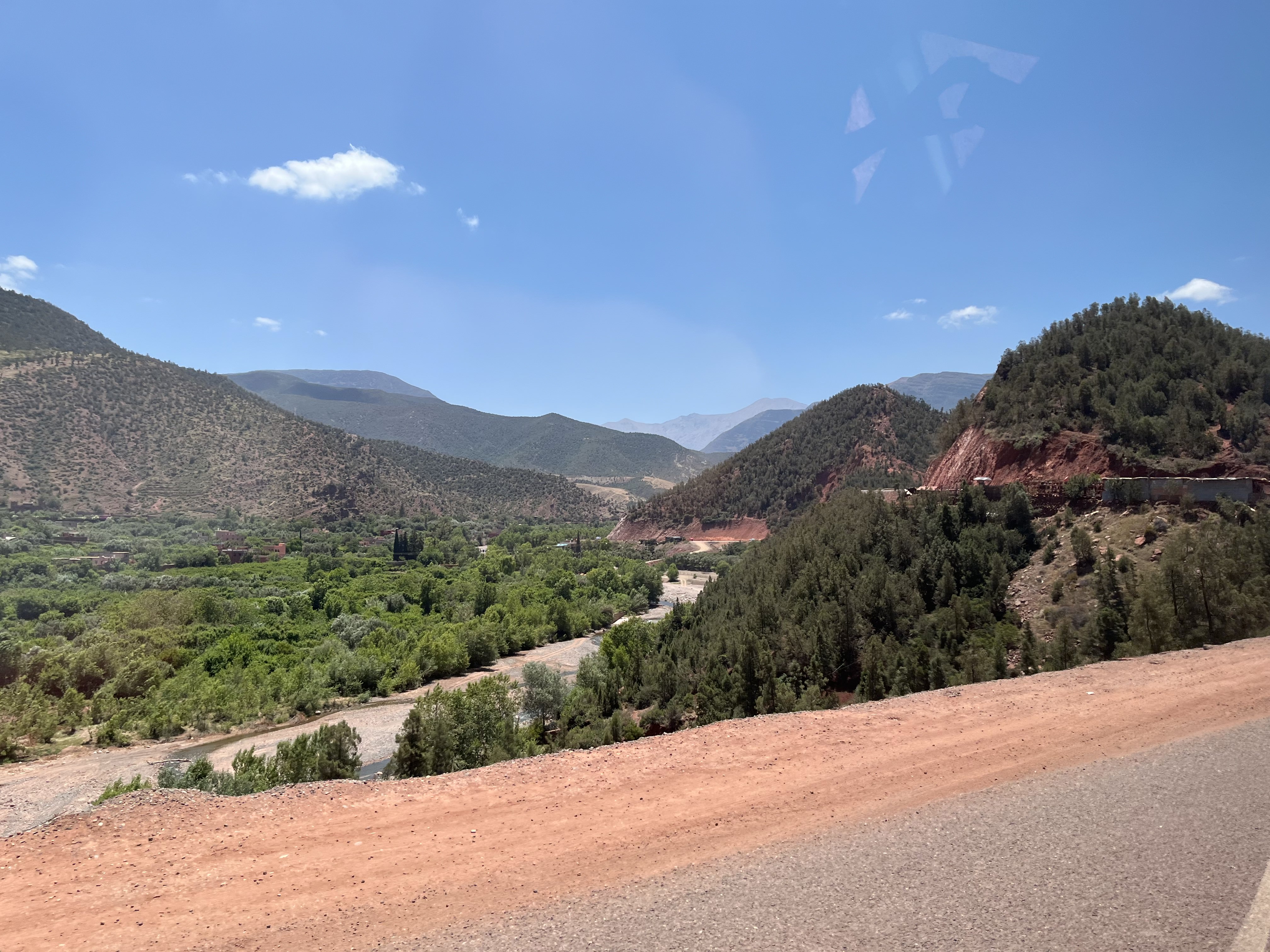
Despite being overwhelmed by all of these fascinating people and the sessions I had attended, a couple of friends and I decided to voyage into the foothills of the High Atlas ourselves. Stunning views greeted us as we meandered through the dry valleys, stopping at markets where venders were offering sticky dates, hot tea, salt mined from local rocks, and a chance to view snake charming. I think I’ve seen enough snakes up-close in Cameroon.
We wandered into a Amazigh carpet salesman shop, the walls absolutely stacked with heavy, intricately weaved carpets. Although we planned to only dart in and out, we ended up talking with the vender for some time. On his terrace overlooking the vast valley of tiny Amazigh settlements perched on top of rock mounds, the man told us of his love for his home, the contentment it brings him to be in the place of his ancestors, where his children now take their turn to learn the names of the wild plants that heal them and always have done.
1 https://doi.org/10.1007/s10531-015-1013-6
2 https://research.kent.ac.uk/cbcd/2018/10/21/dr-gary-martin-and-gdf-protecting-moroccos-high-atlas-landscapes/

 Extreme Citizen Science blog